You're hearing "PCM" in every conversation about cold chain shipping. Your pharma customers are asking for it. Your operations teams are mentioning it. But nobody's explaining what it actually means for your network's competitive edge.
Here's a neat fact: McLaren's been dominating Formula 1 this season, and rival teams suspect they're using Phase Change Materials in their brake drums for tire temperature management. Red Bull's thermal cameras show McLaren's brake drums running significantly cooler than every other team on the grid. When F1 teams are using this technology to gain competitive advantages worth millions in prize money, there's probably something worth understanding for your pharmaceutical network.
Let me break down what PCM actually is, when it works, and why it matters for your transportation strategy.
What Is PCM (The Executive Brief)
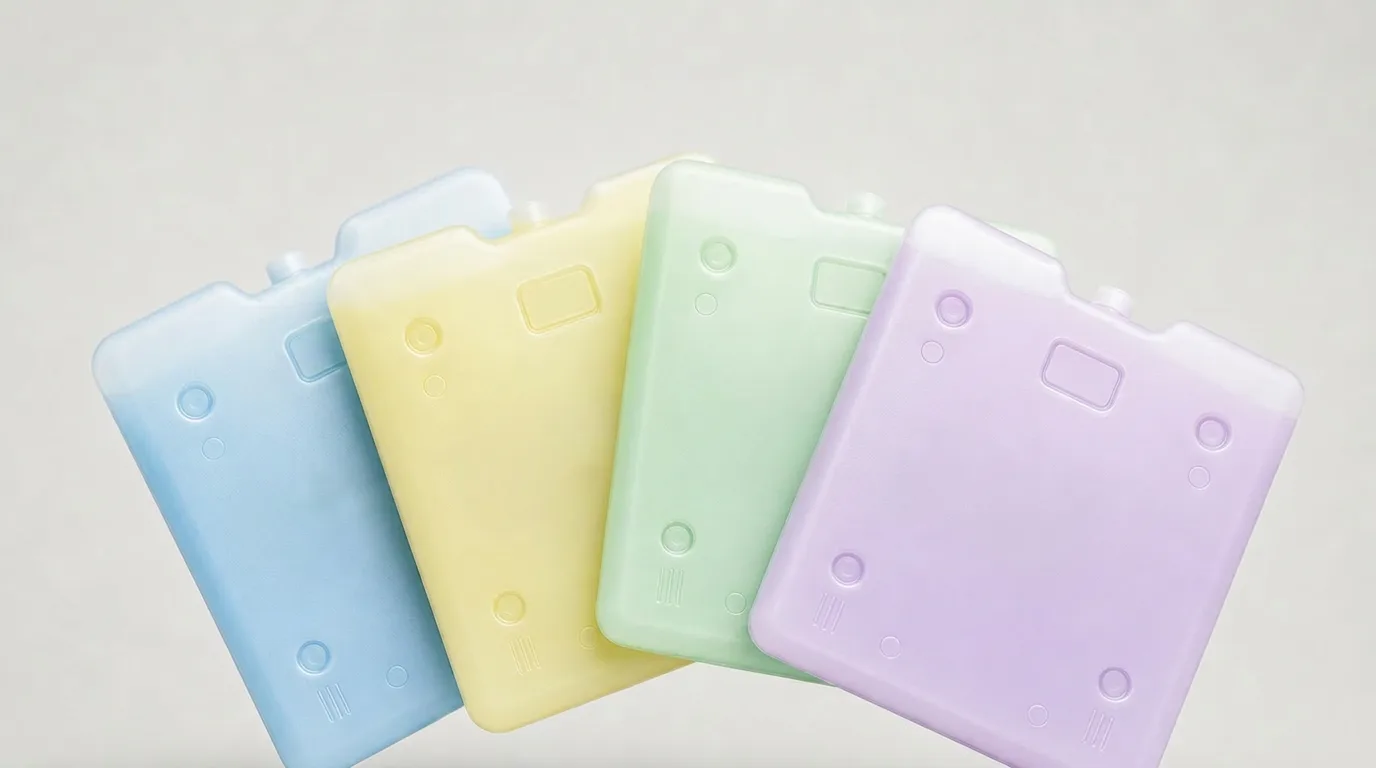
Phase Change Materials (PCM) are substances that absorb or release massive amounts of heat during phase transitions (phase points). This effectively allows you to shift the "phase point" (the temperature at which this energy exchange occurs, the melt and freeze point) to match your specific pharmaceutical shipping requirements.
Think of it this way: Water phases at 0°C; that's where gel packs get their energy. PCMs move that energy release point to whatever temperature you need for the medication being shipped.
When running field tests with PCM, your data loggers will show a temperature plateau at the PCM's phase point while it melts or freezes. That's PCM holding temperature exactly where you need it. Like a thermostat maintaining your cooler's internal temperature while external conditions fluctuate.
The pharmaceutical temperature ranges:
For cold chain applications (2-8°C): Phase Change Materials are designed to phase at target temperatures in the middle of the cold chain range, typically around 4-5°C. This means as your pack-out experiences heat during transit, the PCM absorbs that heat while maintaining stable temperatures right in the center of your 2-8°C target range.
For ambient applications (15-25°C): Lower range PCMs (closer to 15°C) are used for winter protection against freezing. Upper range PCMs (closer to 25°C) are designed for summer protection against overheating. These self-condition at warehouse temperature, eliminating conditioning complexity entirely.
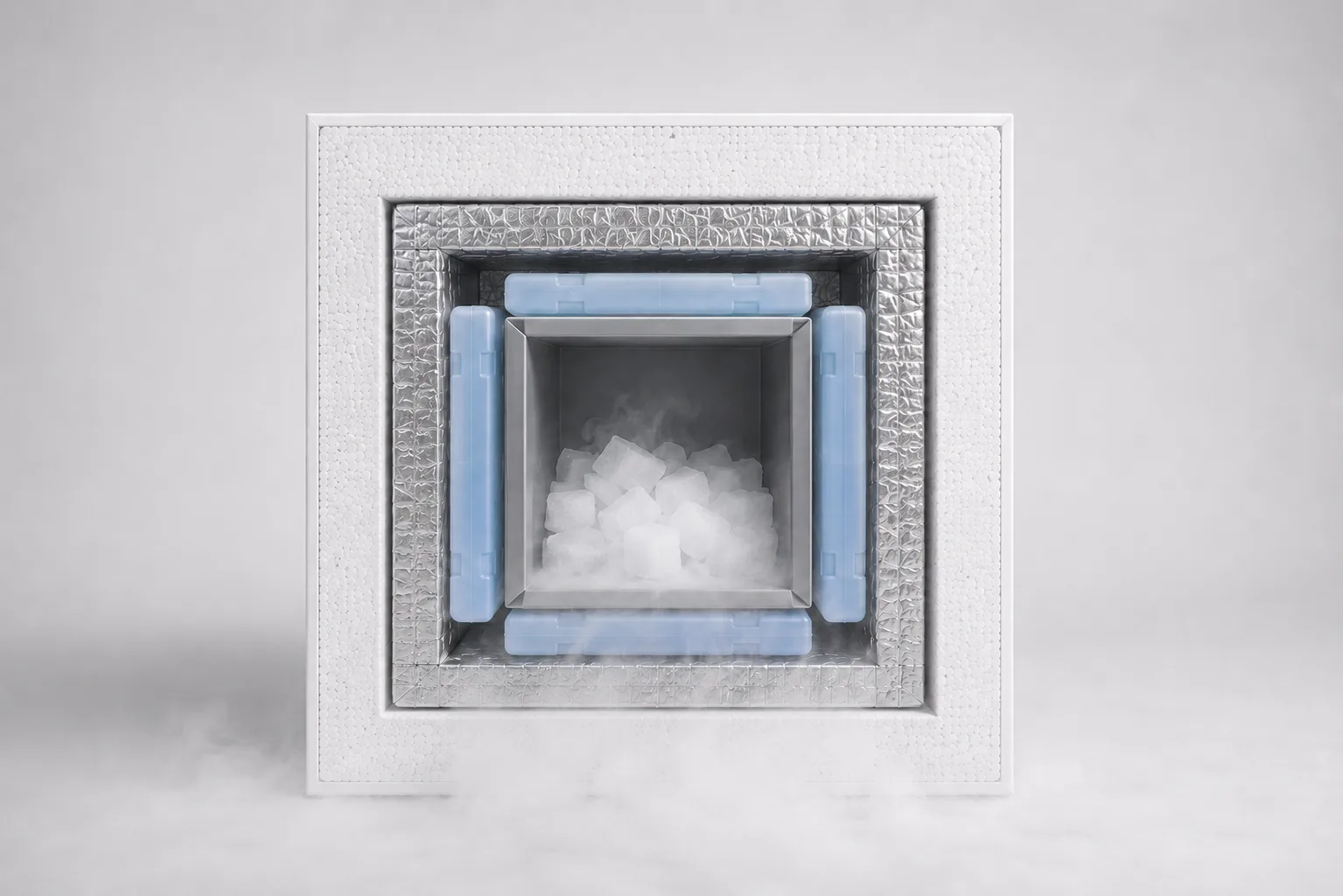
For frozen applications (-15 to -25°C): Specialized frozen PCMs enable dry ice replacement in vacuum insulated panel systems, eliminating hazmat complexity while maintaining ultra-low temperatures.
Technical Details, The Geek Out
When materials change phase, they absorb massive amounts of energy while staying at exactly the same temperature. For 2-8°C applications: PCM 5 absorbs energy while maintaining exactly 5°C. A frozen gel pack starting at -15°C has to warm up through much less efficient sensible heat. That's roughly 80 times less energy per degree.
For 15-25°C applications: Gel packs have essentially no phase energy at ambient temperatures; for this reason, you need a large volume for temperature buffering, which is exactly why those water-based ambient packouts get so big and expensive to ship.
When PCM Becomes Your Competitive Advantage
Cold Chain Applications (2-8°C): The Extended Duration Edge
Standard gel packs work fine for 48-56 hours or less, but once you get into extended duration, where your network's longer transit times could be a liability, PCM becomes your competitive advantage.
PCM 3: Very tight control with more headroom against 8°C heat. It can be a bit cold at the start, so buffer the product carefully if used. This is a unique application I've only seen used in extreme hot climates.
PCM 4-5: The optimal choice. Perfect balance of protection and hold time for 90% of cold chain applications. Ideal for 72-168 hour international shipments paired with vacuum-insulated panel systems, where gel packs just wouldn't be a fit.
PCM 6: Exists but is rarely used. PCM 4-5 remain the workhorses.
Why it matters: If using PCM 4 or PCM 5, you phase at 4-5°C, creating a stable temperature plateau right in the middle of your target 2-8°C range. Frozen gel packs phase at 0°C (the bottom edge of 2-8°C), which is why they require careful conditioning and buffering to avoid thermal cold shock and potential product freezing. Pharma customers get cleaner audit trails with PCM's tighter temperature control.
PCM's cooler strengths: EPS up to about 56-72 hours. VIP for 72-168 hours.
Here's the Big Advantage: Ambient Applications (15-25°C)
This is where PCM separates the smart operators from everyone else. PCM slashes mass, enabling slimmer, cheaper-to-ship packages.
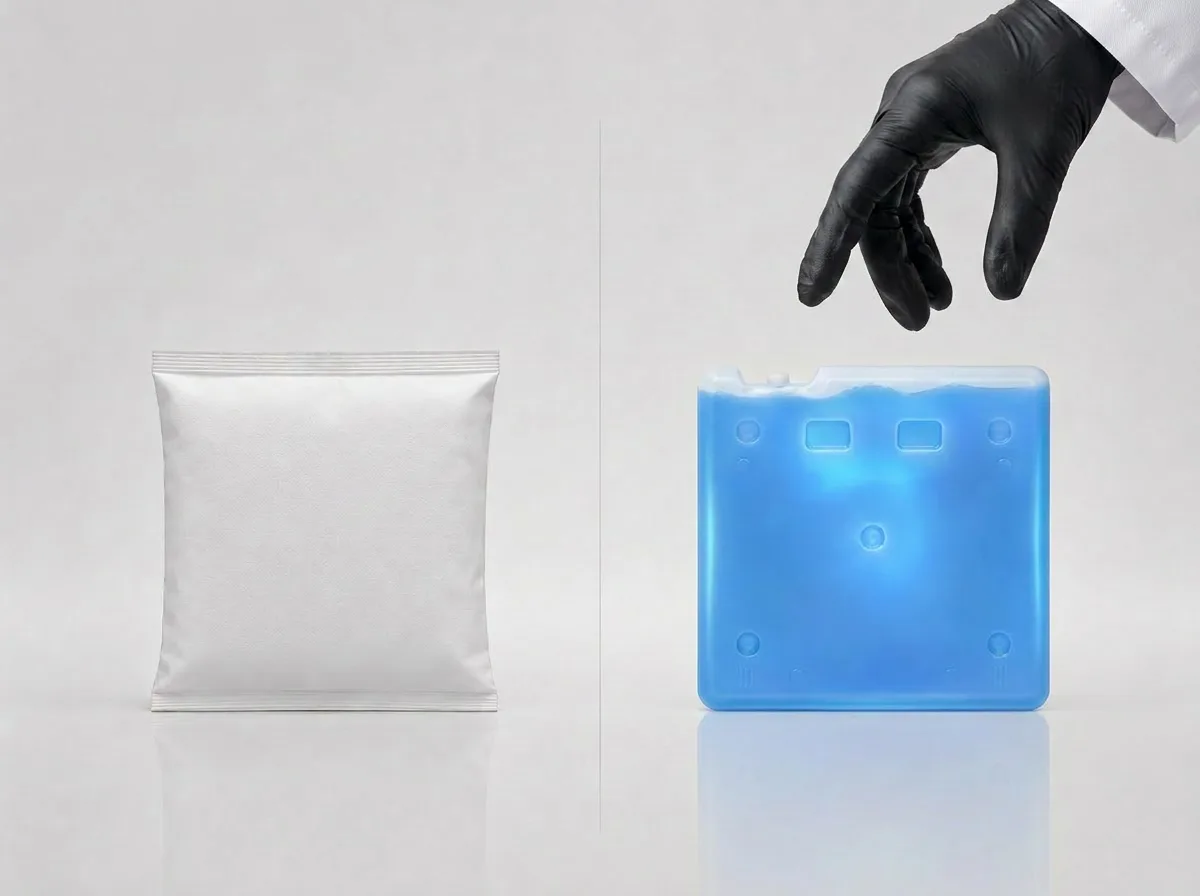
Traditional gel packs have no phase energy at room temperature. They're just bulky dead weight. Why ship bulky room-temperature gel packs when ambient PCM cuts package size by up to 80%? Most pharma facilities run at 21°C ±1°C, which creates the perfect setup for ambient PCM as it will self-condition in your warehouse environment at said temperature, making operations even simpler.
Lower range ambient PCMs (closer to 15°C) are naturally suited for winter protection, starting as liquid at warehouse temperature and releasing heat during cold transit to prevent freezing. Upper range ambient PCMs (closer to 25°C) excel at summer protection, starting as solid at warehouse temperature and absorbing heat during hot transit to prevent overheating. The key advantage: ambient PCMs self-condition at your warehouse temperature, eliminating the conditioning complexity entirely while delivering precise temperature control for controlled room temperature products.
Frozen Applications (-15 to -25°C): The Dry Ice Killer
In practice, PCM -21 really only works in VIP systems. EPS simply can't maintain the ultra-low temperatures needed for frozen PCM to function effectively. EPS containers have R-4 thermal resistance versus VIP's R-40; that 10× better insulation performance makes VIP the reliable choice for ultra-low (frozen) PCM applications.
Frozen PCM's conditioning requirements: Ultra-low freezer at ideally -30°C or below is what I'd recommend for this conditioning application. Some facilities have this capacity. Not many, but they're becoming more popular as biologics shipments increase.
The advantage: More complex from an equipment standpoint, but dramatically less complex from an operational packing standpoint as it eliminates dry ice entirely and is as simple as conditioning standard cold chain PCM once the right equipment is in place. No more hazmat training, sourcing headaches, or sublimation variables.
Ultra-Low Applications (-50°C and below)
PCM -50: Available but challenging. Requires -60°C freezers for conditioning. Most facilities don't have ultra-low freezers this cold.
The reality: Below -25°C, dry ice + VIP becomes the more feasible solution for most operations. You can still get significant benefits by using a VIP over a standard EPS cooler because VIP's superior R-value will use dramatically less dry ice.
The Conditioning Reality
Gel Pack Conditioning:
Here's what most operations miss about gel pack conditioning timelines²:
Individual gel packs need 12-24 hours in standard freezer, full cases require 24-48 hours, and pallets of gel packs can take 21+ days minimum with flat placement and 1-inch spacing, no stacking. The bigger the mass, the longer conditioning takes. Most operations underestimate these timelines.
PCM Conditioning: Operational Simplicity
Cold Chain PCM (2-8°C):
- Standard method: 24 hours freezer, then 24 hours in 4°C fridge (when removed from cases)
- Takes the guesswork out: Your team can load directly from the fridge with no additional bench or sweating time
- Alternative: 24 hours freezer, then 15-40 minutes bench "sweat" with IR gun confirmation (time of "sweating" depends on the size of PCM)
- Pro tip: Colder freezer temperatures condition faster. You can go as cold as your freezer allows, when doing so, you'll just need longer to bring them to proper temperature specification when they are having their "sweat" or "bench" time
- Any residential equipment works for 2°C - 8°C. Nothing special needed
Ambient PCM (15-25°C):
- No conditioning needed for most applications
- Just leave PCM 18 or PCM 23 in your 21°C warehouse (PCM 18 stays liquid for winter, PCM 23 stays solid for summer)
Frozen PCM (-21°C):
- Requires -30°C freezer or below
- Primarily used with VIP containers
Ready to Outsmart Competitors? Strategic Applications Your Customers Are Demanding
Extended duration cold chain: PCM 4/5 systems for unshakeable 72-168 hour performance. Temperature plateaus that pass every audit.
Ambient shipping revolution: Why lose customers to oversized packages when PCM 18/23 envelope mailers and EPS coolers eliminate operational conditioning headaches while making dimensional weight penalties disappear?
Frozen without complexity: PCM -21 systems eliminate dry ice sourcing, training, and regulatory hassles while delivering consistent performance.
The reusable advantage: Higher performing PCM bottles and plates are designed to be reusable when paired with a reusable packout cooler. This eliminates waste and standardizes your seasonal packout strategy. A no-brainer solution for high-volume returnable routes.
Your Strategic Next Moves
Implementation priorities:
- Test PCM 4/5 for extended cold chain with customers facing 56+ hour transit times
- Evaluate PCM 18/23 for ambient applications where package size creates a competitive advantage, or you've been turning away ambient shipments because gel packs simply haven't worked for your operations
- Consider PCM -21 systems for customers wanting to eliminate dry ice complexity
Questions for your operations team:
- What percentage of your pharma shipments require extended duration performance?
- How many ambient temperature shipments could benefit from up to 80% smaller packaging?
- Which customers are asking about conditioning simplification or dry ice alternatives?
- What's your current warehouse temperature, and how does that affect PCM 18/23 conditioning?
The companies that master PCM applications first will offer services that their competitors cannot match. The ones that don't will keep handling oversized, inefficient packages while missing opportunities to solve real customer problems.
If you're not talking PCM with your pharma accounts this year, your competitors already are, and those using it are winning the race alongside McLaren.
References
- Industry analysis of GLP-1 market growth and shipping requirements, 2024
- TempAid Cold Chain, "How To Properly Condition Gel Packs For Pharmaceutical And Vaccine Shipping," January 2024