OPTIMIZING AMBIENT SHIPPING WITH PHASE CHANGE MATERIAL (PCM)
Global demand for precise temperature control in shipping continues to rise, with the overall “cold chain” market growing at an average rate of 15% annually and nearly 40% of that expansion centered in North America.¹ While 2°C–8°C shipping has historically been well-supported by water-based gel packs, an increasing number of pharmaceutical, biologic, and specialty products require Controlled Room Temperature (CRT), commonly 15°C–25°C or 15°C–30°C. For these higher ranges, gel packs often underperform, adding unnecessary bulk and weight without delivering reliable temperature stability.
This article explores how Phase Change Materials (PCMs) address these challenges by offering leaner, lighter, and more consistent thermal management for ambient shipments. Through a detailed case study and comprehensive supply chain analysis, we illustrate how PCMs not only reduce costs but also streamline logistics, minimize waste, and strengthen product integrity.
THE CHALLENGE: WATER-BASED GELS AT AMBIENT TEMPERATURES
Water-based gel packs have a melt/freeze point of 0°C, a feature that works semi-effectively for shipments needing 2°C–8°C control. However ambient ranges around 20°C lead to:
No Relevant Phase Change
Water’s natural freeze point (0°C) delivers limited benefit at higher temperatures.
Heavier Packouts
Gel packs must be used in greater quantity to protect the payload area (where medication is
stored), driving up weight and freight costs.
Inconsistent Buffering
Without a phase transition close to Controlled Room Temperature (ambient), the product experiences temperature swings that can threaten safety and efficacy.
WHAT IS A PHASE CHANGE MATERIAL AND WHY DOES IT MATTER
Most people know water freezes at 0°C, a process involving substantial latent heat absorption or release. Gel packs use this for 2°C–8°C shipping but struggle at 15°C–25°C or 15°C–30°C, where water’s 0°C transition offers minimal help.
A Phase Change Material (PCM) overcomes this limitation by being engineered to melt and refreeze near the actual temperature you need, say, 18°C or 23°C. By shifting the peak heat absorption/release point to that precise range, the payload area remains stable for significantly longer periods than it would with water-based gels.
THE PCM ADVANTAGE FOR AMBIENT
When PCMs are formulated for 15°C–25°C or 15°C–30°C shipping, they provide:
Customizable Phase Points
Tailored precisely to the required CRT range, whether 15°C–25°C or 15°C–30°C.
Higher Latent Heat Capacity
Some PCMs store 5–10 times more energy than water-based gels at these ambient ranges, reducing the total number of packs needed.
Smaller, Lighter Shipments
By delivering robust thermal performance with fewer packs, PCMs reduce the overall refrigerant mass. In contrast to water-based gels, where extra mass is the main driver of thermal control, PCMs achieve the same result with a fraction of the bulk. This lowers actual shipping weight, shrinks overall package size, and cuts dimensional shipping charges, ultimately saving on freight costs.
Consistent Temperature Profiles
Once they reach their designated phase point, PCMs offer greater temperature stability throughout transit, keeping the payload area within range far more effectively than water based gels.
OQ/PQ TESTING: STABILITY IN ACTION
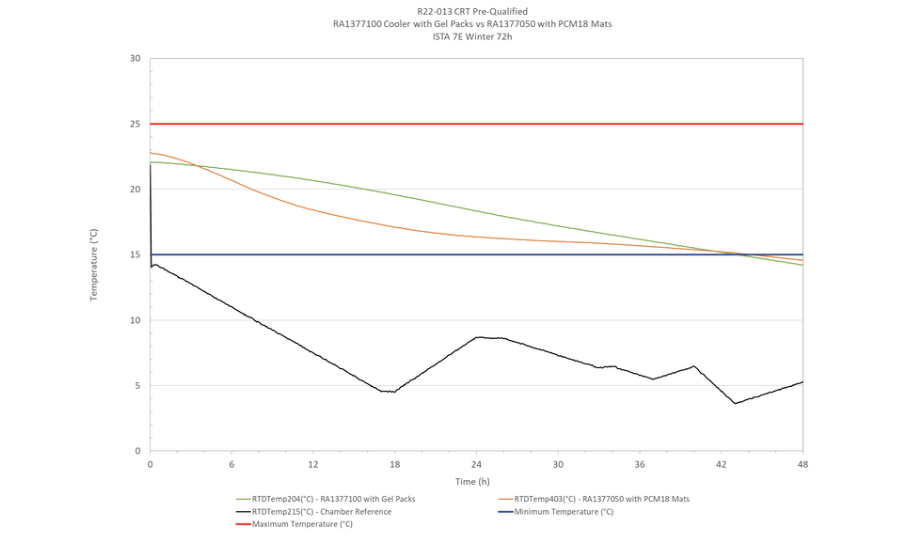
During Operational Qualification (OQ) and Performance Qualification (PQ) testing, PCMs consistently maintain a stable, flat temperature curve aligned with their engineered phase transition. In comparison, water-based gels at approximately 20°C act as mere “buffers” and can show noticeable fluctuations that risk compromising sensitive products. PCMs therefore help manufacturers and logistics providers confirm that shipments meet accrediting bodies and regulatory authority requirements over extended timeframes.
CASE STUDY TEMPAID COOLER FOR AMBIENT SHIPMENTS
To illustrate these benefits, consider 1,000 shipments of 5 – 6L payload each, needing 15°C–25°C or 15°C–30°C control.
Water-Based Gels
- 26L EPS Cooler (TempAid RA1377100)
- 5.57L of usable payload space
- 8 gel packs per shipment
PCM Alternative
- 13L EPS Cooler (TempAid RA1377050)
- 5.91L of usable payload space (slightly more than the 26L water-based option)
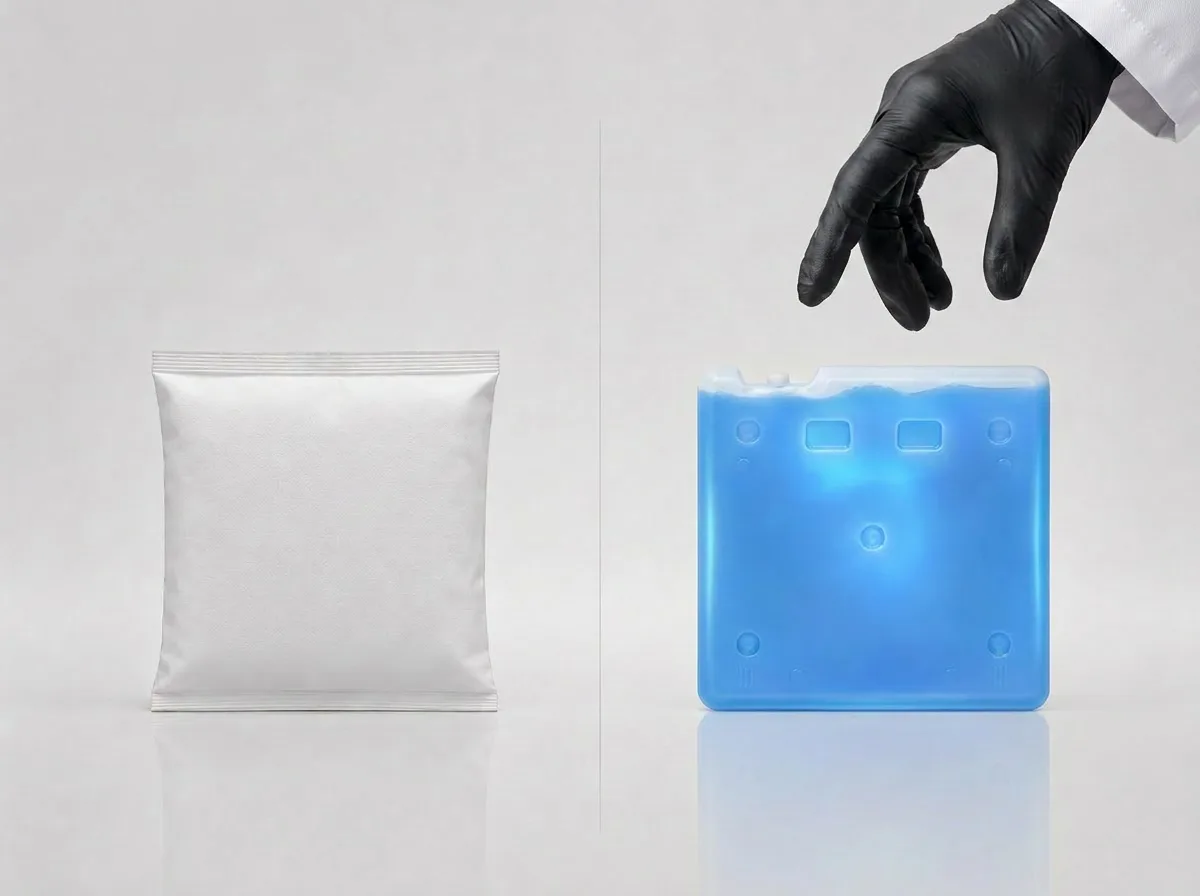
- 4 PCM mats, each formulated for ambient conditions
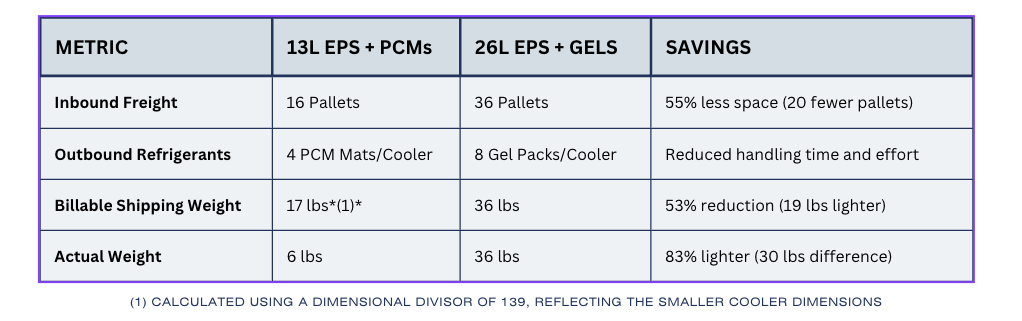
Even though the 13L EPS cooler is smaller overall, it accommodates the 5.91L payload area more effectively. Operational data shows that the PCM-based option maintains tighter temperature control, using fewer packs:
complete SUPPLY CHAIN BENEFIT
Switching to PCM-based solutions delivers value across the entire supply chain:
Smaller Coolers with Larger Payload Areas
Fit a 6L payload area in a 13L cooler instead of a 26L, cutting space and weight.
Less Product to Receive and Store
Fewer PCM mats per shipment and more coolers per pallet mean fewer pallets overall, reducing inbound freight and warehouse needs.
Lower Shipping Costs
PCM-based shipments weigh less both dimensionally and in actuality, dropping freight bills.
Reduced Labor
With fewer components and simpler assembly, personnel can pack shipments faster.
Less Waste for End Users
Replacing bulky coolers and excess gel packs with a smaller PCM system significantly decreases disposal volume, simplifying the recipient’s workflow.
By examining the entire chain, from inbound storage to outbound transit and final disposal, it becomes evident that PCMs deliver broad operational and financial advantages.
CONCLUSION: A BETTER AMBIENT STRATEGY
Switching from water-based gels to PCM solutions for ambient conditions is more than an incremental improvement; it’s a comprehensive operational upgrade:
Lower Freight and Dimensional Weight
Fewer, lighter components optimize shipping costs.
Enhanced Thermal Control
OQ/PQ data confirms fewer temperature excursions.
Streamlined Packaging
Smaller coolers and fewer packs reduce space and handling.
Greater Assurance in Product Safety
More stable temperature profiles safeguard medication efficacy.
End-to-End Supply Chain Savings
Less inbound product, less labor, and simpler disposal drive cost savings at every step.
When shipping at 15°C–25°C or 15°C–30°C, PCM’s provide clear advantages in cost, performance, and reliability, helping the pharmaceutical industry do more with less and maintain consistent quality standards for temperature-sensitive products.
Have questions about ambient shipping, phase change materials or temperature safe packaging? Reach out to TempAid.
References
1. https://www.intermodal.org/documents/APB239007_Cold_Chain_text_Engl_VF.pdf